Mixture Models For The Old Faithful Dataset
The Old Faithful dataset is a pretty classic mixture model example (see, e.g. Bishop PRML). There are a couple of different version of this –- I'll use the one from the RDatasets.jl package.
old_faithful = dataset("datasets", "faithful")We can plot the data:
EDA
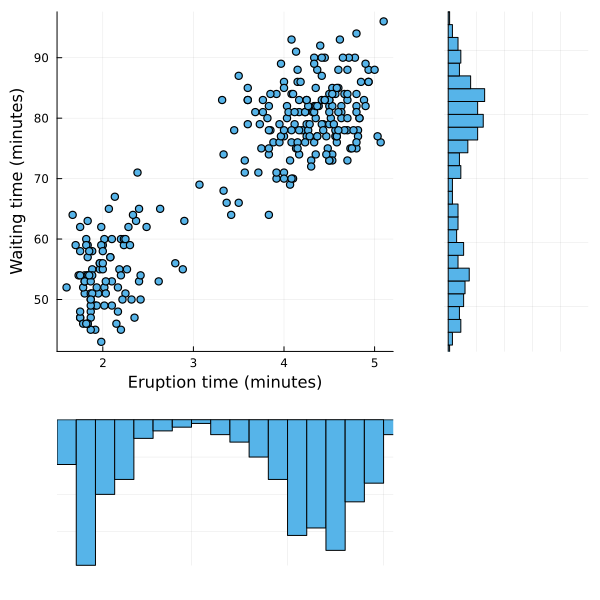
Click Me For Plotting Code
l = @layout [a{0.7w} b{0.3w}; c{0.7h} d{0.3h}]

# Main scatter plot
p1 = scatter(old_faithful.Eruptions,
             old_faithful.Waiting,
             color = 3,
             legend = false,
             xlabel = "Eruption time (minutes)",
             ylabel = "Waiting time (minutes)");

# Horizontal histogram for waiting time
p2 = histogram(old_faithful.Waiting,
               color = 3,
               orientation = :horizontal,
               legend = false,
               title = "",
               bins = 30,
               ylims = (minimum(old_faithful.Waiting), maximum(old_faithful.Waiting)),
               yaxis = false,
               xaxis = false);

# Upside-down histogram for eruption time
p3 = histogram(old_faithful.Eruptions,
               color = 3,
               title = "",
               yflip = true,
               xlims = (minimum(old_faithful.Eruptions), maximum(old_faithful.Eruptions)),
               yaxis = false,
               xaxis = false,
               bins = 30,
               legend = false);

# Placeholder for alignment
p4 = plot(legend = false, axis = false, grid = false, foreground_color_subplot=:white);

# Combine plots with adjusted layout
plot(p1, p2, p3, p4, layout = l, size=(600, 600))
Note: As of Plots.jl version 1.39.0, orientation = :horizontal does not swap the xlims, so you need to do this manually.
Model One: 1D Mixture Model
Let's implement a simple one-dimensional mixture of Gaussians for the eruption time data: